
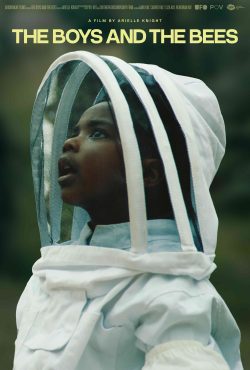
The Boys and the Bees:
Q+A with Arielle Knight
There’s something disarming about watching children discover the world. The Boys and the Bees, directed by Arielle Knight, is a short film about two young brothers who spend their days learning about bees, animals and the land around them on their family’s Georgia farm. But beneath its gentle pace and beautiful landscapes, the film is also about something much bigger: Black boyhood, freedom, masculinity and the small window of childhood before the world begins to place its expectations on you.
We spoke with Arielle about finding the family on Instagram, letting a story unfold, and why she wanted to make a film that doesn’t tell us what to think.
Q. You found this family through Instagram. What was it about them that made you think, “There’s a film here”?
Someone sent me one of their Instagram videos, knowing that I love nature and kids and that I’m from the South. I watched a couple of the videos and I was just really taken by them. There was something about these images of the boys in their bee suits. I just felt really drawn to them. I had never done this before, but I sent them a message saying, “Hi, I’m a storyteller, and I’ve fallen in love with your family just as a follower.” It turned out they lived in Georgia, where I’m from, so the next time I went home I asked if I could meet them. We went on a hike and connected pretty instantly.
Q. The film feels incredibly calm, especially considering there are bees, animals, kids and a farm involved. Was that calmness something you were intentionally looking for?
I was working on a feature at the same time that was taking a long time and was kind of a drag emotionally, and I wanted to make something that I could start and finish that felt good. I wanted something that still centered the things I care about thematically, but was a little lighter. And then being with these kids was just really incredible. They’re so curious. They’re like new humans learning about the world, and I think being able to spend time with them and watch them discover things was really special.
Q. At some point, you had to stop trying to capture the boys and just let them be. What did they teach you about filmmaking?
After the first day of filming, I took the kids off on my own and tried to direct them. I put them in beautiful lighting and gave them actions to do, trying to capture them doing the things I knew they did. And it just didn’t work. They didn’t listen to me. It was chaotic. It felt really stiff. I realized I had to just let go and be there for whatever happened, and trust that whatever was drawing me to this family was going to lead me to the story. I had to trust that there was a film there and not try to construct it like a puppet master.
I’m really curious about alternative forms of masculinity and how we’re thinking about raising boys into men. But I think the film lets you experience that rather than explaining it.
Arielle Knight
Q. You’ve described the film as being about the “freedom and magic” of boyhood. What does that freedom mean to you?
I was thinking very deeply about Black boyhood and freedom. I was making another film about my cousin, who was incarcerated, and I was thinking about the moment when a young Black boy who is joyful and protected and free and curious shifts, and his experience changes. He becomes withdrawn and defensive and criminalized by the world, and in turn that changes who he is and how he moves through the world.
I was really thinking about that small moment in time when children get to be just free and unburdened by the things that later burden them as they move into young adulthood and adulthood. I didn’t want to make a film that explicitly talked about that. I wanted you to feel that moment. These boys reminded me of my cousins, and of that moment when they were at their freest.
Q. Nature is almost another character in the film. What does the land give these boys?
The family’s farm is also this incredible classroom. Their dad runs a wildlife removal company, so animals are constantly coming into their world. They’ll rehabilitate animals and release them, and all of that becomes a way for the boys to learn about animals and the outdoors. Now they have cows and chickens and pigs and goats, and the farm is really transforming.
Q. What does it mean to raise boys differently?
I’m really curious about alternative forms of masculinity and how we’re thinking about raising boys into men. But I think the film lets you experience that rather than explaining it. There are a lot of different things happening in the film, depending on who you are and what you’re bringing to the viewing. For me, the first impulse was about boyhood and the freedom and magic of this moment in children’s lives.
Q. What do you hope people carry with them after watching The Boys and the Bees?
It’s been incredibly affirming for me to see that cinema is not dead, it’s very much alive and very much needed right now. Film allows us to enter into worlds that we otherwise would never enter into, and to relate to people that we may not know or ever know, and to see some of ourselves in those stories.
And ultimately, I hope the film can help people reconnect with nature and the outdoors. We did this incredible screening on the family’s property with about 100 families, where we had a farm day, beekeeping demonstrations and conversations about cultivating land. My dream is that we can curate more screenings like that, particularly with families of color, in urban areas and in the South, and use the film as a way for people to come outside and rebuild those relationships with nature.
The Boys and the Bees won the Short Film Jury Award for Nonfiction at the 2026 Sundance Film Festival, and premieres on PBS November 16.
An ecosystem where artists bring stories to life, funders believe in the power of stories, and partners connect audiences with stories.
Request invitation to join the 3Roots Community to receive updates on upcoming events, select film opportunities, and our newsletter!
For questions or inquiries, we would love to hear from you at Contact@3Rootsmedia.com