
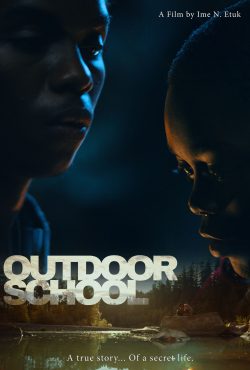
Outdoor School: Q+A Ime N. Etuk
Outdoor School tells the true story of a 12-year-old boy experiencing homelessness and domestic violence in Portland, Oregon – and the week at Outdoor School that changed his life. But for filmmaker and Lion Speaks founder Ime N. Etuk, telling that story was only part of the mission.
We spoke with Ime about the real-life story behind Outdoor School, why impact sometimes means reaching just one person, and what it takes to create change both in front of and behind the camera.
Q. Let’s start with the story behind Outdoor School. How did you first come to know Melvin “Vin” Shambry and realize that his experience was a story you wanted to bring to the screen?
I met Melvin on a film set, and when I heard his story, I just couldn’t shake it. He told me that when he was 12 years old, he was sleeping in an inner city park under a tree at night with his mom and sister fleeing domestic violence. But by day he was going to middle school like any other kid. He had these neon patent leather Nikes that his friend’s dad had given him, and those shoes became this kind of badge of honor that helped cover up the shame of his poverty.
Then he went to outdoor school, which is this rite of passage for kids in Oregon, and that experience changed him. I remember thinking, there is something really powerful here. Not just about homelessness or domestic violence, but about what happens when a kid is given an opportunity to experience himself differently.
I had actually been working on another project at the time, but I decided to pivot and tell Vin’s story instead. And Vin became a producer on the film, so he wasn’t just the person whose story we were telling. He was involved throughout the entire process. That was really important to me because I wanted to make sure we were telling his story with him, not just about him.
Q. This film deals with some heavy issues, but you chose to make it in a way that can be viewed by families and kids of all ages. How and why did you make that choice?
I think it’s important that kids have films that reflect their true experiences, and making something powerful doesn’t mean making it explicit. Sometimes what’s implied is more powerful than what’s seen.
Domestic violence is present throughout Outdoor School, but you never actually see it. And the feedback we’re getting, especially from people who have experienced domestic violence, is that our approach was more impactful than films that depict it graphically. Seeing a woman cover a black eye with makeup at her office gives an intimate look at what it means to live with that. People engage with the film at the level of what they’ve encountered in their own lives, and that means families can experience it together.
So is it worth it for that one kid? Absolutely. We're excited about the film's impact on the world, but it's the impact on individuals we've seen along this journey that tells me this film was worth making.
Ime N. Etuk
Q. What have you learned about impact from making and touring this film?
You drive five hours to show the film in a theater that seats 100 people, and sometimes you ask yourself, “Is this really worth it?” But in Ashland, I had an experience that reminded me how important this work is.
There was a kid standing outside the theater. He looked about 11 or 12, and he was there by himself. We got him a ticket to see the film, gave him some popcorn and candy, and he ended up helping us hand out resource guides. At the end of the night, he asked us for a ride home.
On the way, he told us what his day had been like. He had taken a bus to a neighboring city to see his father, and his father turned him away. He rode the bus back, got dropped off downtown, and ended up at our theater. When we got to his home and met his mom, we realized his life was not so different from our character’s. She was dealing with domestic violence, and the family was facing housing instability, many of the same things Vin’s mother had gone through. We were able to give her the resource guide and connect her with the local organizations that had just spoken at our screening, people who could help her that same week.
And for that kid, in that moment, he got to see that his story was worth telling. He got to be around adults who listened to him and told him he was valued.
So is it worth it for that one kid? Absolutely. We’re excited about the film’s impact on the world, but it’s the impact on individuals we’ve seen along this journey that tells me this film was worth making.
Q. The film is also about changing who gets to tell stories. Why was it important to build opportunities behind the camera while you were making the film?
When I got into film, I went through a Directors Guild training program. They took 14 people out of more than 1,000 applicants, and I was the only Black person in my year. It was an amazing fast track, but it’s not a realistic way for most people to access the industry. You might be a young parent, you might have bills, and you can’t afford to work for free while you learn. So I thought, what if I could mirror that training without the barriers? What if people could show up because they were interested, get trained, and get paid? That became part of the model for Outdoor School. Through my nonprofit organization Lion Speaks, we trained about 30 apprentices and created pathways for people to get onto sets and, for some, into the union.
I wanted to tell two stories: the one in front of the camera that people were coming to see, and the one behind the camera about who gets access to this industry. To me, they’re equally important. What I’ve learned is that it’s not enough to just teach people technical skills. You have to put them on real sets and connect them with people who are actually working in the industry. The relationships matter. That relational currency is just as important as knowing how to do the job.
Q. What do you hope Outdoor School makes possible next?
I want the film to keep having a life. We’re building partnerships with organizations that can use the film in their own communities. The goal is not just to get people to watch it. It’s to connect them with the people already doing the work and give them a way to start healing.
I also want the model behind the camera to continue. I want more productions to understand that you can make a powerful film and create opportunities behind the camera at the same time. You can bring people in, train them, pay them, and connect them with people who are working in the industry. There doesn’t have to be one without the other.
We want to keep making stories that resonate with people’s real lived experiences, and we want those people involved in how their stories are told. Storytelling is an incredible way to connect people to each other and to transform hearts and minds. But there’s a big difference between someone telling their story and someone having a story told about them. Too often, gatekeepers decide which stories get told about a community. Independent film is one of the few places where the people living the story get to be the ones telling it. That’s what we did with Vin, and that’s what I plan to keep doing.
An ecosystem where artists bring stories to life, funders believe in the power of stories, and partners connect audiences with stories.
Request invitation to join the 3Roots Community to receive updates on upcoming events, select film opportunities, and our newsletter!
For questions or inquiries, we would love to hear from you at Contact@3Rootsmedia.com