
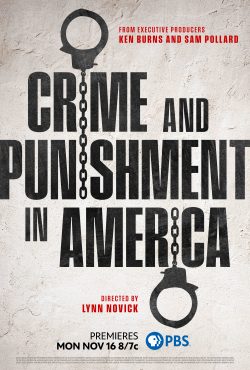
Crime and Punishment in America: Q+A with Lynn Novick
Filmmaker Lynn Novick has spent decades telling stories about American history, but Crime and Punishment in America began with a realization that surprised even her: she didn’t really understand the history of incarceration in the United States. The four-part, eight-hour documentary series directed by Lynn Novick and produced by Ken Burns and Sam Pollard, traces how America developed its modern system of crime and punishment – and asks what understanding that history might make possible today. The project grew out of College Behind Bars, Lynn’s 2019 PBS documentary about incarcerated students pursuing higher education.
We spoke with Lynn about what she learned from both films, what she hopes audiences take away from the series, and why she believes documentaries can create something we desperately need: proximity.
Q. What first drew you to the history of incarceration in America?
After Prohibition was released, my producing partner Sarah Botstein and I were invited to present the film to a college class inside a maximum-security prison through the Bard Prison Initiative in New York State. We had one of the most profound and eye-opening conversations about our work, our process and our choices with these incredibly engaged students, and we walked out of there thinking, “Wow, that was amazing. Someone should make a documentary about this program.”
As it happened, I was given the opportunity to teach there myself, and that allowed me to get to know the students, faculty and administrators and really understand how the program worked. By the time that was done, Sarah and I had decided we had to make the film. We filmed over several years, following people as they applied to college, went to college, graduated and came home. That became College Behind Bars, and that film led me to a much bigger question: how did we get here?
Q. What assumptions about incarceration did you begin to question?
Working on College Behind Bars, I realized pretty quickly that I didn’t really know anything about the history of crime and punishment. People often ask me, “What surprised you?” and I kind of want to say –and I don’t mean to be flip– everything surprised me because I didn’t know anything. I’m a fairly well-informed person and a student of American history, but I’d never really looked at our history through this lens.
One of the huge aha moments for us working on the film was the realization that there have been prisons, but they weren’t institutionalized in the way that we have them today, and they weren’t linked to a promise of rehabilitation. They weren’t for people who had committed what we would call ordinary crimes. This whole construct had to be created and caught on, and now it’s so baked into our society that we can’t imagine it wasn’t always here.
Q. What do you hope audiences take away from Crime and Punishment in America?
All of us who worked on the film hope the film can shed some light on this complex and often tragic history without pointing fingers or blaming. I think blaming is such a toxic dynamic in our culture right now. Can we all take some accountability and responsibility for the way things are, understand how we got here, and have a meaningful dialogue about what we need to do to move forward?
There are no easy answers, unfortunately. But I think too often in America we haven’t even tried. We talk about crime and people who are in prison in very sensational and dehumanizing ways, and I hope this film, in all of its complexity and nuance, allows for a much deeper conversation and for people to maybe open their minds and hearts to think about how we can do better.
I hope this film, in all of its complexity and nuance, allows for a much deeper conversation and for people to maybe open their minds and hearts to think about how we can do better.
Lynn Novick
Q. Why is it important to understand the history behind the system we have today?
This system isn’t going to get better at all if we don’t at least acknowledge the past and recognize this history in an honest way. It sounds obvious, but proximity is really the key to any serious problem. If you haven’t experienced something, you don’t know. If you or someone in your family or someone you love hasn’t experienced incarceration, crime or police violence, you might think you know, but you just really don’t know. You might not even care.
A documentary gives us an opportunity for that proximity that a lot of people simply haven’t had. I’ve seen this over and over again in all the work we do, and I think it’s most urgently true here. A documentary can’t help but at least make people stop for a second and think, and maybe ask questions.
Q. What can long-form documentary storytelling do that other forms of storytelling cannot?
There’s nothing wrong with short-form storytelling, but so much of what we encounter is something we swipe through to the next thing. We have this long-form, immersive experience, and we find there are big audiences for that. People who want that deep dive, a chance to really sink into something they don’t know about, learn, and hear stories they didn’t know. And I think that’s part of what documentaries can do: give people the opportunity to get close to something they might otherwise never encounter.
Q. How are you thinking about partnerships and conversations beyond the film itself?
We have some things in the works that aren’t official yet, so I can’t say too much. We have been working with an organization called The Just Trust, which is one of our funders. They’ve generously supported our project, and we’re working with them to make the film available to many of their grantees and to other organizations that can use it in their own work. We’re just getting started.
Q. After spending so much time with this history, what gives you hope?
I had the privilege of interviewing Bryan Stevenson for this project, and I asked him that question. I said, “how can you be hopeful in this really difficult time?” He said, “I can’t not be hopeful.” Hope is the enemy of hopelessness. Hopelessness is giving in to just the way things are. So we have to find ways to find that hope that we can do better. I think it’s sort of a discipline, in a way.
Catch Crime and Punishment in America airing on PBS starting November 16.
An ecosystem where artists bring stories to life, funders believe in the power of stories, and partners connect audiences with stories.
Request invitation to join the 3Roots Community to receive updates on upcoming events, select film opportunities, and our newsletter!
For questions or inquiries, we would love to hear from you at Contact@3Rootsmedia.com